Last reviewed November 2026.
Deck footing depth and snow load by town
Every office below sets its own design criteria. The ones that publish them online agree on frost depth and differ on snow and wind:
| Office | Frost depth | Ground snow | Wind | Code |
|---|---|---|---|---|
| Fort Collins | 30 in | 35 psf | Gust map | 2024 IRC |
| Loveland | 30 in | 35 psf | 130 mph east of Taft | 2024 amendments |
| Larimer County (unincorporated) | 30 in | 55 psf and up | 115 to 225 mph | 2024 codes |
| Johnstown | 30 in | 30 psf | 115 mph | 2024 IRC |
| Severance | 30 in | 30 psf | 115 mph | 2024 IRC |
| Windsor, Timnath, Wellington, Berthoud | Ask the town | Ask the town | Ask the town | Ask the town |
Swipe sideways to see every column.
Sources linked below. Loveland's figures come from the City's own Table R301.2 amendment (revised December 2022); confirm them with the City's Building Division. No criteria table was found for Windsor, Timnath, Wellington or Berthoud; check with each town's building division.
Behind the short cells: Fort Collins' 35 psf is its residential default, its wind comes from the Front Range gust map with over 140 mph west of Overland Trail, and it has enforced the 2024 IRC since April 1, 2026. Loveland uses the gust map west of Taft Avenue and has adopted 2024 code amendments; check the effective date with the City. Larimer County's snow figures are strength level, 55 psf at 5,000 feet and 70 at 6,000, with wind by the county map and 2024 codes from January 1, 2026. Johnstown's criteria apply from January 1, 2026, Severance's 115 mph is an ultimate design speed, and Timnath has used the 2024 IBC since January 1, 2026.
Town pages repeat their own rows: Loveland, Johnstown and Severance. The county numbers are explained in the Larimer County deck permit guide.
Why 30 inches
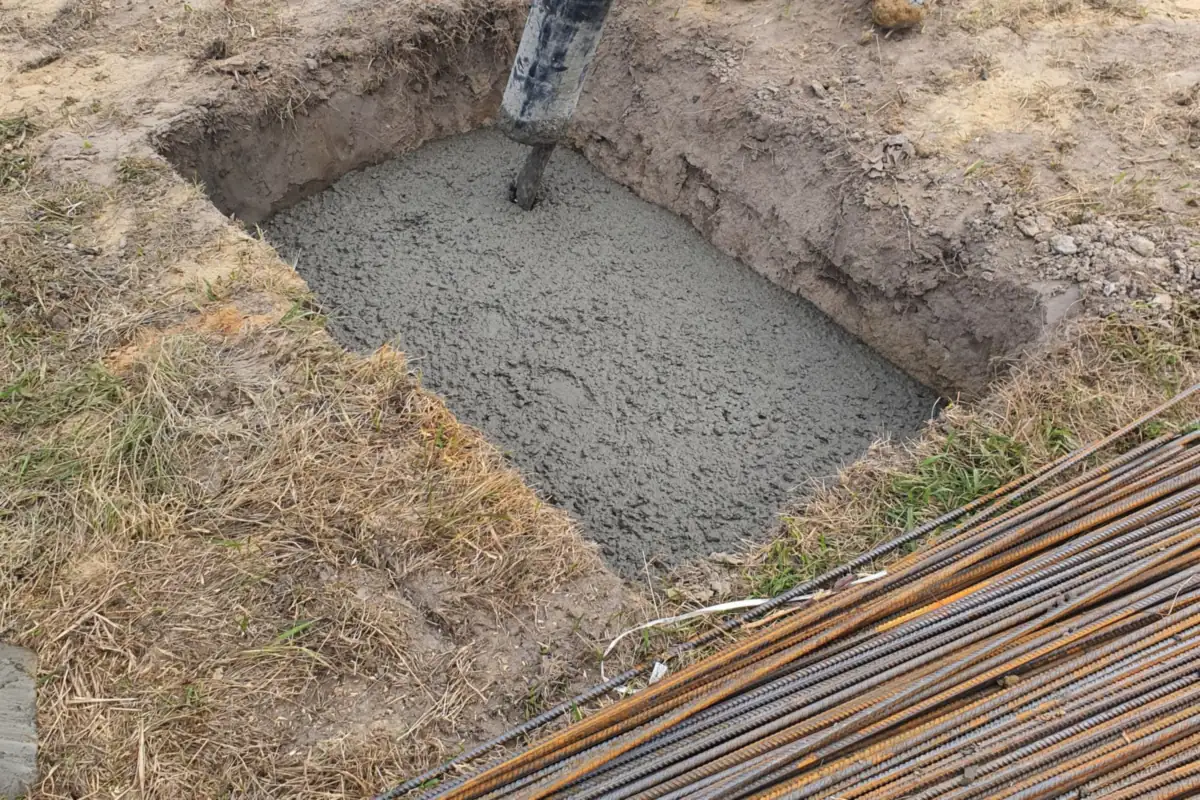
Soil that freezes expands, and a footing above the frost line gets pushed up each winter and settles back each spring. For a deck bolted to a house that means a ledger being pried up and down, the most common reason old Front Range decks drift away from the wall. Footings below 30 inches sit in ground that doesn't freeze. Fort Collins lets a freestanding deck use 12 inch piers because it can move a little without tearing at anything.
How big each footing should be
Footing size follows tributary area: the square feet of deck each post holds up, measured halfway to the next post or beam in each direction. Fort Collins' simplified chart, at 1,500 psf soil bearing and 40 psf live load, gives these round pier diameters, and Larimer County's handout matches them:
| Tributary area (sq ft) | Pier diameter |
|---|---|
| 5 | 8 in |
| 20 | 12 in |
| 40 | 16 in |
| 60 | 19 in |
| 80 | 22 in |
| 100 | 25 in |
| 120 | 27 in |
| 140 | 29 in |
| 160 | 31 in |
Source: City of Fort Collins Residential Deck Guide (Table R507.3.1 simplified); Larimer County deck handout, 1,500 psf soil column. Engineered decks and other soils use their own sizes.
Worked example
A 12 by 16 deck attached along its 16 foot side, with joists spanning 12 feet to a beam on three posts 8 feet apart, puts about 6 feet by 8 feet, or 48 square feet, on the middle post. That falls between the 40 and 60 rows, so the pier is at least 19 inches across and 30 inches deep.
Higher in the foothills
Larimer County's handout also steps its footing tables up with elevation, because ground snow rises with it: 40 psf up to 5,500 feet, 50 psf to 6,500, 60 psf to 7,000 and 70 psf to 8,000, with engineering required above 8,000 feet. On the same 1,500 psf soil, the same post needs a wider pier the higher the house sits:
| Tributary area (sq ft) | Up to 5,500 ft | 5,501 to 6,500 ft | 6,501 to 7,000 ft | 7,001 to 8,000 ft |
|---|---|---|---|---|
| 20 | 12 in | 13 in | 14 in | 14 in |
| 40 | 16 in | 17 in | 19 in | 20 in |
| 60 | 19 in | 21 in | 23 in | 24 in |
| 80 | 22 in | 24 in | 26 in | 28 in |
| 100 | 25 in | 27 in | 29 in | 31 in |
| 120 | 27 in | 30 in | 32 in | 34 in |
| 160 | 31 in | 34 in | 37 in | 40 in |
Swipe sideways to see every column.
Source: Larimer County Residential Deck Information handout, minimum footing size tables at 40, 50, 60 and 70 psf ground snow (Hem-Fir #2 framing). Fort Collins sits near 5,000 feet, in the first column.
Rock, posts and soil
- Solid rock inside 30 inches: in Larimer County the footing can stop on it, with a 12 inch #4 rebar doweled 6 inches into the rock and epoxied, or per engineered plans.
- Posts within 8 inches of grade, or within 1 inch of the concrete pier, must be treated lumber (Larimer County handout).
- The county tables assume 1,500 psf soil. Designing for more needs a design professional's justification: above 1,500 psf on the Front Range, or above 3,000 psf in the foothill and mountain wildfire hazard area.
- Diamond Piers and other manufactured footings: Fort Collins wants the maker's specs with the plans, and an engineer when they carry a second-story deck or one more than 10 feet to the top of the beam.
Snow on decks, covers and pergolas
An open deck sheds snow through its gaps and is designed for people, at 40 psf live load. Snow load becomes the governing number the moment a roof goes overhead: a covered deck or covered patio is framed for the local ground snow, plus drift where it sits below a taller roof. In Fort Collins a cover bearing on a deck needs an engineer for exactly this reason.
Strength-level vs default numbers
Larimer County's January 2026 sheet multiplies Colorado snow data by 1.6 to give strength-level values under ASCE 7-22, so it lists 55 psf below 5,000 feet. Fort Collins' page shows a 35 psf residential default and 50 psf (ultimate) for multifamily and commercial work. The figures aren't in conflict; they are on different bases. Use the one from the office issuing the permit.